
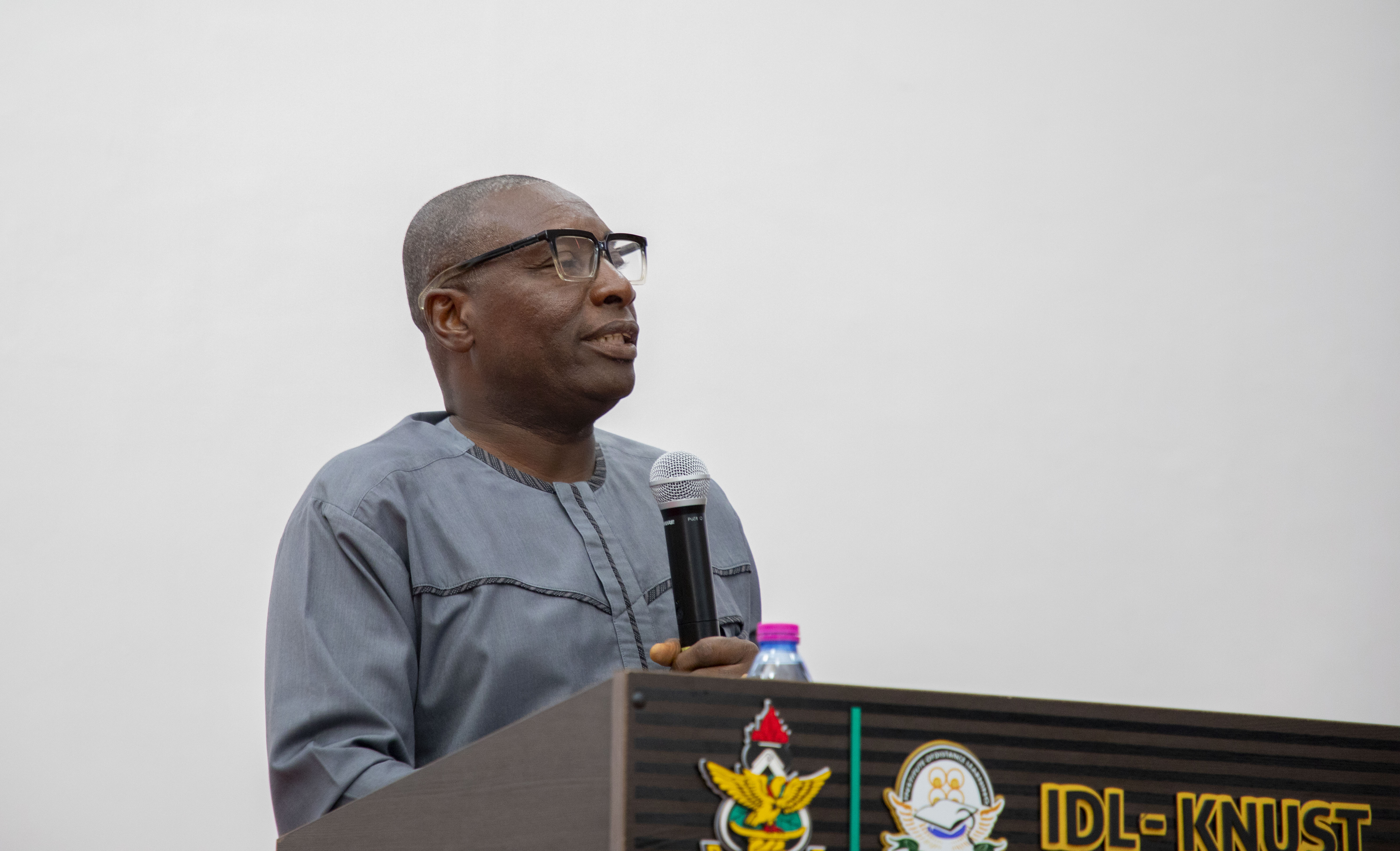
University administrators must demonstrate their value through sound advice, effective management and practical reforms, says retiring KNUST Deputy Registrar Mr Anthony Adjapong, who argues that supporting an institution does not make their work subordinate or second class.
Speaking at an exit seminar organised by the Registrar’s Offices on October 29, 2026, the College Registrar for the College of Art and Built Environment urged colleagues to take pride in their profession while making themselves useful to the university’s development.
“Support is not subordination. Support is not second class,” he said.
His reflections combined an account of more than 18 years at the Kwame Nkrumah University of Science and Technology, Kumasi, with specific proposals on examinations, staff transfers, event protocol and the relationship between academic and administrative leadership.
The seminar brought Mr. Adjapong and fellow retiring Deputy Registrar Mr Owusu Ansah Debrah together with serving and retired administrators to share lessons from university service.
Administrative leadership and professional standing
Mr. Adjapong argued that administration runs through every stage of education, from deciding what kind of institution to establish and mobilising resources to admitting students, employing teachers and maintaining the conditions for teaching, learning and research.
He said choosing teaching as a profession did not place it above administration. Strong administrative systems, he argued, provide the foundation on which academic work depends and deserve corresponding recognition and investment in staff.
Across four colleges, the Institute of Distance Learning and Academic and Student Affairs, he said, the Registrar’s work consistently required leadership, management and advice.
Leadership involved offering opinions and proposing policy changes through memos and position papers. Management meant ensuring that people and material resources were available and deployed appropriately. Advisory work required helping boards, committees and officeholders make informed decisions.
He described coordination as the function connecting these responsibilities, with the Registrar’s desk receiving and applying processes and procedures to keep work moving. In his account, administrative support is the foundation carrying the institution’s visible work.
“Honestly, if I am pushed to the wall, I will choose administration again and again and again.”
His defence of administrative work was accompanied by concerns about what he saw as the declining standing of administrators within the university.
He said responsibilities associated with the Registrar’s Offices appeared to be moving away piecemeal, citing examination functions exercised by academic colleagues and examination officers. He questioned why a function closely associated with the title “Registrar” was being carried out elsewhere.
He argued that an emphasis on teaching, learning and research had contributed to administrative and professional senior members being treated as less important. Registrars, he said, were too often regarded simply as secretaries, with their wider responsibilities insufficiently recognised.
As an example, he pointed to administrative matters being referred to Provosts and Deans, who then directed Registrars to act. He believed this practice reinforced the impression that administrators were merely carrying out instructions.
He also criticised inconsistent processes and insufficiently defined boundaries between academic and administrative leadership.
To address these concerns, he proposed changes to the definition and exercise of administrative authority.
For the Registrar, he proposed clearly defining academic and administrative leadership, setting out their relationship and codifying those arrangements. He also called for clarification of whether officeholder appointments were personal, or “in personam”, or institutional, or “in institutionem”, with advice provided accordingly.
For Academic Affairs, his recommendation was to take control of examination coordination immediately.
Policy reform through memos
To illustrate his contribution, Mr. Adjapong identified 11 memos through which he said he had influenced changes in university practice.
The first addressed what he described as wrongful mileage claims for journeys from Sunyani to Brosankro and Kumasi.
Several others concerned affiliations. One proposed issuing affiliation certificates at reasonable intervals. Another called for temporary affiliation to cover institutions while their applications were being processed and the required fees paid.
He also proposed KNUST representation on the governing boards or councils of affiliate institutions to strengthen mentorship, and the establishment of benchmarks to guide the affiliation process.
A further memo proposed fixing a permanent date for Health Training Institutions’ graduation ceremonies.
Within KNUST, he drew attention to inconsistencies in the university’s vision and mission statements across official documents. He also co-authored a memo raising concerns about inclusion and ownership in implementing Plan 2K25.
Two memos addressed graduation arrangements: seating Council members appropriately and developing a symbolic procedure for dispatching graduates at the ceremony.
The final memo he listed called for conspicuous displays of the university’s vision, mission and core values to help guide behaviour.
Staff development and mentorship
In August 2017, Mr. Adjapong moved to the School of Business, where he spent four and a half academic years as School Secretary. He said the assignment offered a degree of autonomy similar to his earlier work in Sunyani.
His staff included senior and junior employees, contract staff and national service personnel. He held periodic meetings and organised training to help them improve their work.
Mr. Adjapong received his first promotion in 2013 and his second, to Deputy Registrar, in 2020. In January 2022, he moved to the College of Science as College Registrar, continuing his emphasis on staff development.
He described training initiatives for technicians and plans to train administrative staff, but said another transfer prevented him from completing the latter. In December 2023, he moved to the College of Art and Built Environment, where he has served since.
These experiences informed his concern that rotations and transfers did not appear to follow a planned path of professional development. He said transfers lacked progressive movement and had become an executive function.
An earlier transfer had also left him without a defined assignment. At the Institute of Distance Learning, where he worked between January and November 2016, he assisted Acting Institute Registrar Mr Ebenezer T. Otieku.
He said he had barely settled into the role when a round of transfers returned him to Academic Affairs. There, he was given a desk without a defined schedule, with instructions for Deputy Registrar Mrs Margaret Dzisi to find work for him.
After a period without a specific assignment, Acting Registrar Mr Ben Onumah Andoh assigned him responsibility for university ceremonies, principally matriculation and graduation.
His experience of a damaging assessment in Sunyani provided a separate lesson about seeking advice during difficult periods.
While in Sunyani, he received an assessment he considered deeply damaging. He recalled panicking before deciding to consult people he trusted. He spoke with Dr Ankamah-Lomotey, Paul Addo and Prof. Odai.
Dr Ankamah-Lomotey reassured him that if the report did not reflect who he was, that would become apparent. Mr. Adjapong said the advice stayed with him and helped him navigate the experience. His lesson for colleagues facing similar difficulties was to consult senior officers and make use of their guidance.
For Human Resources, he called for more serious attention to staff and student orientation so that newcomers could understand their environment and responsibilities and be encouraged towards good conduct. He stressed that first impressions mattered and recommended arranging local transfers in a progressive manner.
For Deputy and College Registrars, he proposed periodic engagement with staff at different levels to discuss their responsibilities and ways of improving productivity.
Across the University Relations Office, Human Resources, Academic Affairs and college administration, he repeated a common requirement: those in charge should provide leadership and mentorship to their subordinates.
Alongside formal training and mentorship, Mr. Adjapong emphasised good rapport across staff groups. He encouraged a warm, respectful and thoughtful approach, grounded in humility and service.
As a Faculty Officer and College Registrar, he said, he maintained close contact with national service personnel, junior and senior staff, and fellow senior members. He thanked colleagues for their friendship and support and asked forgiveness from those who might have been displeased when he expressed his opinions strongly.
Institutional partnerships and university ceremonies
Building connections across institutional boundaries was another recurring part of his work. As pioneer Assistant Registrar at the Faculty of Forest Resources Technology in Sunyani, under the College of Agriculture and Natural Resources, he served from August 2008 to March 2011.
He recalled a quiet campus whose distance from Kumasi left it feeling disconnected from the main university. To strengthen those links, he attended meetings and major activities of the Registrar’s Offices, examination coordination meetings and College Board meetings. He also secured agreement for the faculty’s new students to travel to Kumasi for their medical examinations.
In Affiliations, where he spent four academic years, he coordinated KNUST’s relationships with partner institutions. The work involved extensive travel and required a sound understanding of university procedures.
Mr. Adjapong said he learned to represent affiliate institutions’ concerns within KNUST while ensuring, during visits to those institutions, that they met the university’s requirements. He recalled growing demand for affiliation and said the then National Accreditation Board, now part of the Ghana Tertiary Education Commission, directed new private institutions towards KNUST.
He also recalled helping the Midwifery Training College at Atibie organise a ceremony, an engagement he credited with encouraging nursing training colleges then affiliated to the University of Ghana to seek KNUST mentorship. In his account, the development concerned the then Vice-Chancellor, Prof. W. O. Ellis, who feared that the University of Ghana might interpret it as interference with its affiliation arrangements.
Guiding affiliate institutions through matriculation and graduation ceremonies also prepared him for his later responsibility for KNUST ceremonies. After returning from Sunyani, he had taken an interest in rehearsals, observing Deputy Registrars D. Kumi Djan and Regina Nuako and Senior Assistant Registrar Matthew Amoako, working under Dr V. A. Ankamah-Lomotey in Academic Affairs.
He said that experience helped him manage university ceremonies and brought positive feedback from colleagues and students.
Drawing on that experience, he recommended a simple University Relations Office protocol list that would avoid lengthy acknowledgements of every conceivable dignitary at ceremonies.
He also recommended shorter introductions for staff chairing events, limited to their current office and title. Colleges, faculties and departments, he said, should involve the University Relations Office in planning, programming and delivering their events.
He recommended reviewing the use of secondary school students to fill the Great Hall during important university events and reconsidering expenditure on event T-shirts that might not be worn again.
Research and professional service
Mr. Adjapong’s professional service extended to numerous committees and the role of Clerk of Convocation. He organised and supported conferences, seminars and training programmes, and moderated functions as a master of ceremonies.
He served two terms as Vice-President of the Ghana Association of University Administrators and two terms as President, with the presidency covering 2020 to 2024. He also belongs to the Institute of Public Relations, Ghana.
His fundraising work supported the University’s Foundation, the Registrar’s Offices, the School of Business and a book launch for Prof. K. K. Adarkwa.
He helped organise an international business association conference in 2019 and represented the School of Business at education fairs in Nigeria that year and in Nairobi, Kenya, in 2021.
He attended the fifth International Conference on Quality Assurance in Higher Education in Africa at Félix Houphouët-Boigny University in Cocody, Abidjan, where he co-presented a paper on regulating technical and vocational education for national development in Ghana. He also attended a conference in Kigali, Rwanda, in 2018.
His publications include two co-authored papers. One examined the effect of an admissions policy for less-endowed students on access to tertiary education in Ghana and appeared in the British Council’s “Going Global: Inclusion, Innovation, Impact”, Volume 4. The other considered stakeholders’ perceptions of quality in distance education and the implications for educational administration in Ghana, appearing in the Ghana Journal of Higher Education.
A path into university administration
His own route into the Registrar’s Offices began with a return from Denmark and an encounter with an old university friend.
Born in Tamale and raised in the Catholic faith, Mr. Adjapong attended primary school in Kumasi and Tema before continuing to St. Hubert Minor Seminary in Kumasi. Before university, he undertook national service in the Records Unit of the Old Tafo Clinic, now the Old Tafo Polyclinic, and taught at All Saints Preparatory School at Adiemra while awaiting admission.
He completed his undergraduate studies at KNUST in 1992 and served as National Coordinator of the International Movement of Catholic Students, IMCS-Pax Romana, from 1992 to 1994. From 1993 to 2001, he taught English Language, History and English Literature at Adanwomase Senior High School, including English Literature for its final batch of Ordinary Level students.
After obtaining a Master of Arts degree at Aalborg University in Denmark in 2004, he returned to Ghana in September 2005, convinced that this was where he could make his most useful contribution.
A newspaper advertisement for the KNUST Registrar’s position in 2006 attracted his interest in working at the university. During a visit, he went to see Kofi Appiah Koranteng in Office 214. Koranteng, the late Kwame Anane Adam and Harley Anane had been his undergraduate contemporaries.
When Koranteng asked where he worked, Mr. Adjapong described himself as a newly returned “burger”. His friend handed him application forms for a non-teaching senior member position and encouraged him to apply.
Mr. Adjapong worked briefly with SIC Insurance Company from 2007 before joining KNUST. He and Charles Asamoah Boateng assumed duty as Assistant Registrars on May 2, 2008, and underwent orientation until August.
Outside work, Mr. Adjapong enjoys travelling, music, football, athletics, volleyball and tennis. His career profile describes him as a team player with independent judgement and an interest in leadership.
Collegiality and institutional continuity
Mr. Adjapong also acknowledged the leaders and colleagues who had supported his work.
He served under five Vice-Chancellors: Prof. K. K. Adarkwa, Prof. W. O. Ellis, Prof. Kwasi Obiri-Danso, Prof. Rita Akosua Dickson and Prof. Christian Agyare. He expressed appreciation for the rapport and working relationships he had with them.
He thanked four Registrars: the late Mr Kobby Yebo-Okrah, Mr Ben Onumah Andoh, Mr Andrew Kwasi Boateng and Mr Benjamin Boampong Owusu. Each, he said, had allowed him the latitude to work while representing the Registrar’s Office at his various postings.
He also acknowledged Prof. R. C. Abaidoo, then Provost of the College of Agriculture and Natural Resources, and Prof. Isaac K. Dontwi, then Director of the Institute of Distance Learning.
His acknowledgements included Prof. Imoro Braimah, then Provost of CASS, now the College of Humanities and Social Sciences; Prof. Charles Ofosu Marfo, then Provost of the College of Humanities and Social Sciences; and Prof. Leonard K. Amekudzi, then Provost of the College of Science.
At the College of Art and Built Environment, he thanked former Provost Prof. John Tia Bugri and current Provost Prof. Christian Koranteng.
Among senior administrative colleagues, he acknowledged Mr Yaw Owusu Asamoah, who served as Acting College Registrar at the College of Agriculture and Natural Resources during his Sunyani posting; Dr V. A. Ankamah-Lomotey and Mr K. A. Karikari, under whom he worked in Affiliations; and Mr Ebenezer T. Otieku, with whom he worked at the Institute of Distance Learning and later the School of Business.
He also recognised Mrs Margaret Dzisi formerly in Academic Affairs and Mr Solomon Panford formerly at the College of Humanities and Social Sciences. He said their professionalism and collegiality had made work enjoyable.
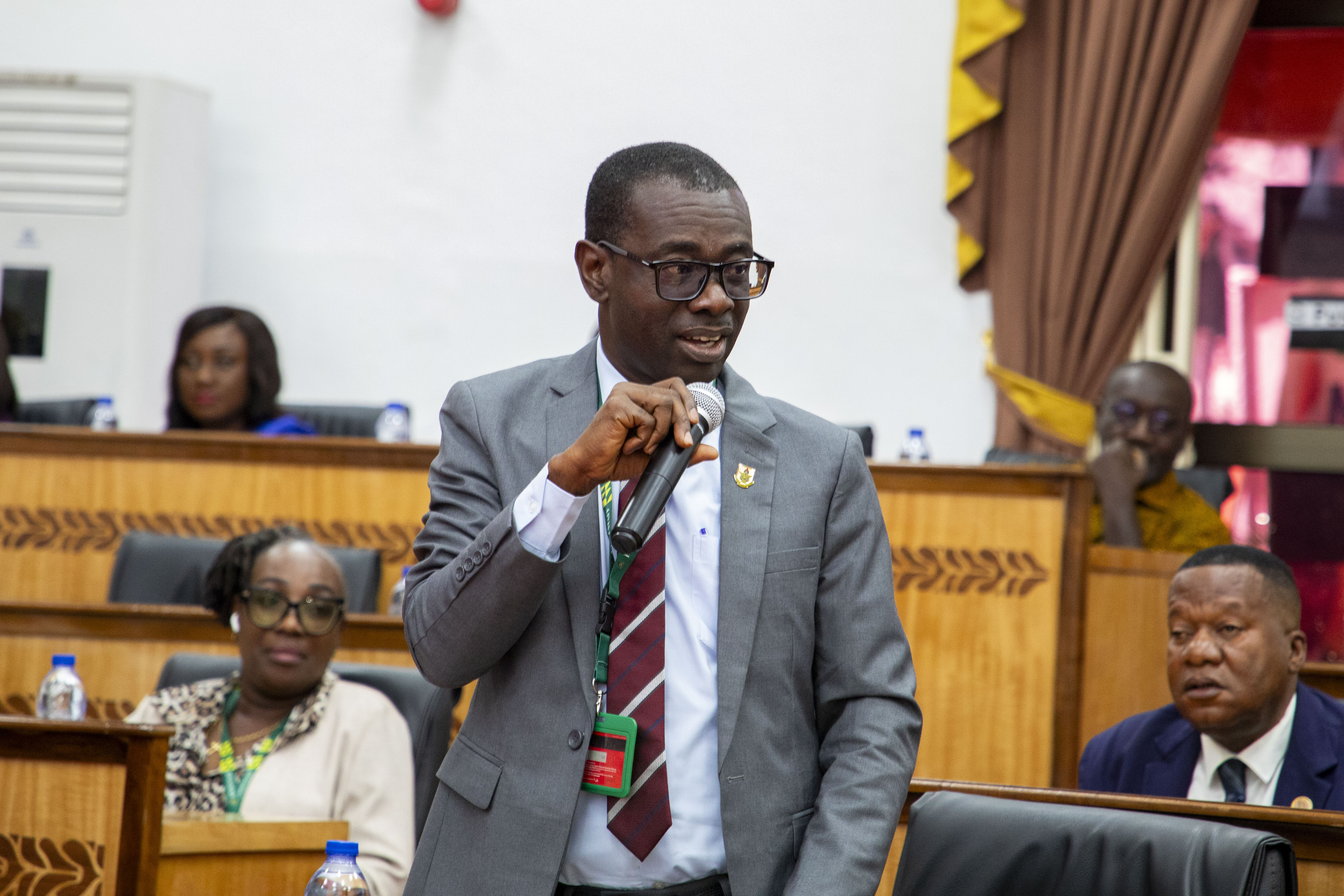
The Registrar, Mr Benjamin Boampong Owusu, described the exit engagement as an opportunity to preserve institutional knowledge, support mentorship and succession planning, and improve administrative practice and service delivery. Participants also discussed difficult workplace relationships and balancing professional obligations with personal commitments.
“We recognize and appreciate their contribution to university administration and policy implementation,” Mr Owusu said.
Mr. Adjapong had opened his address with a line from Thomas Gray’s “Elegy Written in a Country Churchyard”: “The curfew tolls the knell of parting day”. He used it to mark the approaching end of his and Debrah’s working lives at KNUST.
Looking back, he recalled the late Registrar Kobby Yebo-Okrah telling him and Charles Asamoah Boateng that they had joined KNUST at a good and promising time. Although he had not fully understood the remark then, he said he was leaving with a sense of fulfilment despite the difficulties he regarded as occupational hazards.
For Mr. Adjapong, frustration over status should not become a reason to withdraw from the work. He urged colleagues to believe in themselves, understand their responsibilities and contribute to KNUST’s pursuit of “Excellence to Eminence”, leaving an institution that would attract others to careers in university administration.
He described his own approach as seeking opportunities to make a difference wherever he was posted, and his contributions as modest. His closing challenge linked recognition to continued usefulness.
“Indeed, if we must be recognized for what we should be, we must be and remain relevant.”
Story: Abigail Ofori & Emmanuel Kwasi Debrah Photos: Alex Tovor Tamakloe


